Whether as a group of three or a team of five, the journalistic investigation into the obstacles Latinos face in navigating and accessing mental health treatment was a grueling and mentally taxing challenge for each of my colleagues, particularly for me for two very specific reasons:
I had to shed my prior knowledge of health issues to help my colleagues reach a level of understanding where we could discuss the issues and make ourselves understood, in order to continue the research. I also had to validate with experts and primary sources that what I understood to be “true” was actually true, or at least that I could verify that it was.
The investigative journalism we did in this class taught me that we—journalists— don’t know anything until we confirm it . And if we don’t, we can’t claim it as valid or known. It’s different from journalism and less in-depth agenda-driven journalism, in which a certain amount of honesty is attributed to the journalist’s “word” and they are believed because they cover their source or because they are supposed to do their work according to the ethical standards of the profession.
Here, in investigative journalism, that doesn’t count. Yes. We’re supposed to do honest, principled work, but the work and the journalist are only as valuable as their sources . And I’m very clear about that now. This kind of journalism is furious, thorny. It takes you out of your comfort zone, even if you don’t want it to be. It challenges you and makes you bow down to others and even to yourself—and to the ideals or prejudices you initially held.
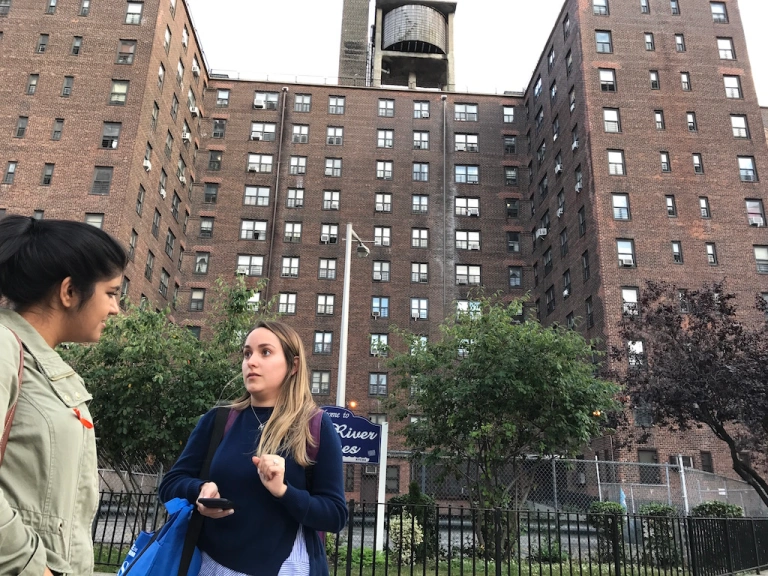
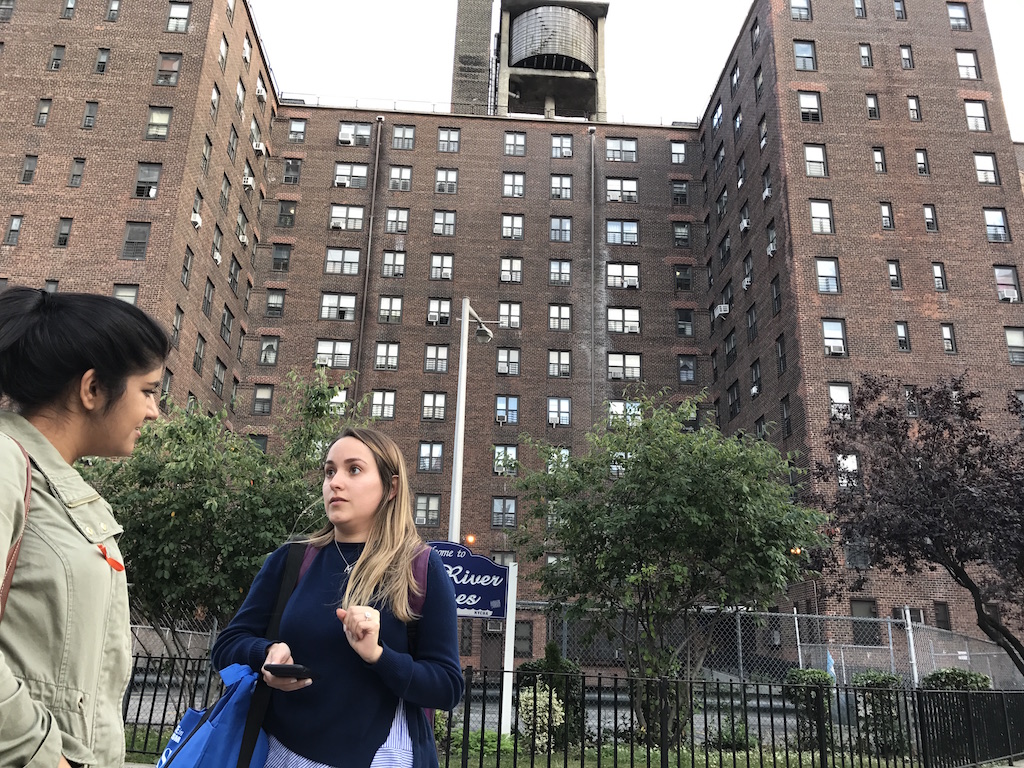
Hanaa’ Tameez and Maritza Villela in East Harlem. August 2017.
That’s why it was a challenge to interview Carmen de la Rosa, the assemblywoman for the 72nd district of the State of New York, alongside Hanaa’. I had to ask her questions about the changes she proposes with the suicide prevention law in Upper Manhattan, instead of profiling her and praising her work , as would have been done for any Dominican newspaper.
Covering the Out of the Darkness walk with Maritza and Hanaa had a different element. This time, it wasn’t a daybook, it wasn’t a review of the event. We had a deeper goal: to find cases and sources that we could use for our research on Latinos, suicide, and mental health in New York City.
That’s where we met Wanda Figueroa , who, in addition to being one of our research experts, has become the main character in my capstone profile.
Through this research, I’ve learned to better cultivate my sources. I’ve stayed in touch with Wanda, as she lost one of her five children in May , when she took her own life. And in an effort to create better opportunities for people with mental health issues, she organized a bake sale at her workplace. I was there to document it. Wanda’s willingness led me to Staten Island, to meet the people she works with and the community she serves in the emergency room at Richmond University Medical Center.
And, to the extent that she saw my commitment to the Latino community, to health and science issues, she offered to let me get to know her better and even invited me to the birthday party she held to honor the memory of her deceased son. This journalism has taught me to be intimate.
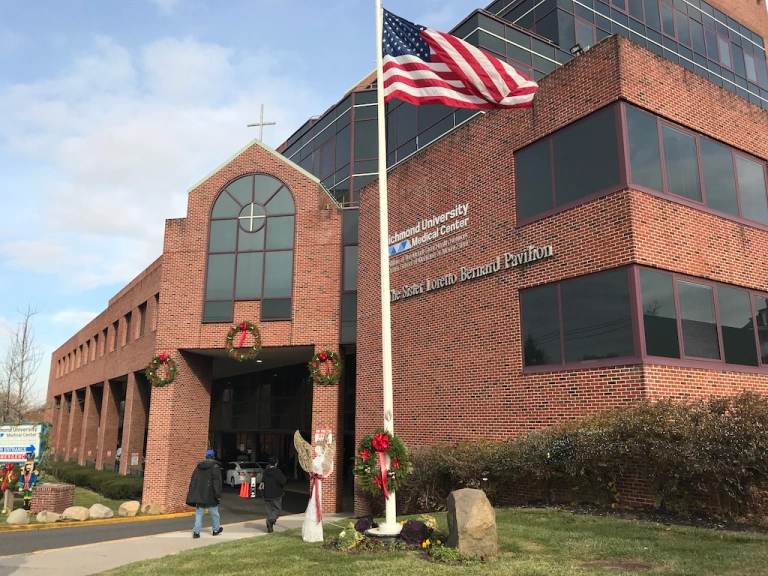
Richmond University Medical Center, in Staten Island. Nov. 2017.
And it’s also taught me to question the winds. I remember that at some point in our investigation, we reached a point where we were all stuck and didn’t know how to confirm that the information our sources were giving us was true or related to each other. And I had to ask for help , which in places like the Dominican Republic is an “absurd” thing to do if you want to call yourself a journalist. Well, journalists are supposed to know everything.
That’s when I reached out to Katie Jennings and Dan Goldberg , reporters for POLITICO in New Jersey and New York, respectively, to get their advice on who to talk to with our questions and information. That’s how we found Laura Kassel, program coordinator for Medicaid Matters in Albany, NY.
Thanks to the work we did for this investigation, I have a much better appreciation for the value of clear transcription of notes —zero hieroglyphics. And for the almost stubborn organization. This is what helped us find the sources where we had sought specific data and figures, and return to them when it came time to write the investigative report. I learned this from my colleagues when I worked on joint documents in which we included articles of interest and—in my case—sources on health care policies and the Medicaid program.
Finally, the best lesson I’ve learned is that I’ve better developed my capacity for patience, humility, and common sense . I remember Hanaa’ and I went to a community health center in Washington Heights that offers mental health services. We waited for the supervisor for at least an hour while observing the environment at the Community Health Network. We didn’t get any cases, but we left there having met the supervisor, established a connection with her, heard about the health coverage situations patients had access to, and saw how vulnerable people are who are unfamiliar with how health insurance systems work.
In a way, this class allowed me to experience firsthand what I’d been taught in my introductory health journalism class. And, honestly, this was the only class during my master’s degree that allowed me to cover one of the topics I want to cover for the rest of my journalism career in my preferred language. What a pleasure to have gotten lost in the mental health labyrinth.
Essay written as a final memo on the Mental Hell research project, with Hanaa’ Tameez, Maritza Villela, Nicole Acevedo, and Julia Sclafani, for professors Ginger Thompson and Cristina Maldonado.